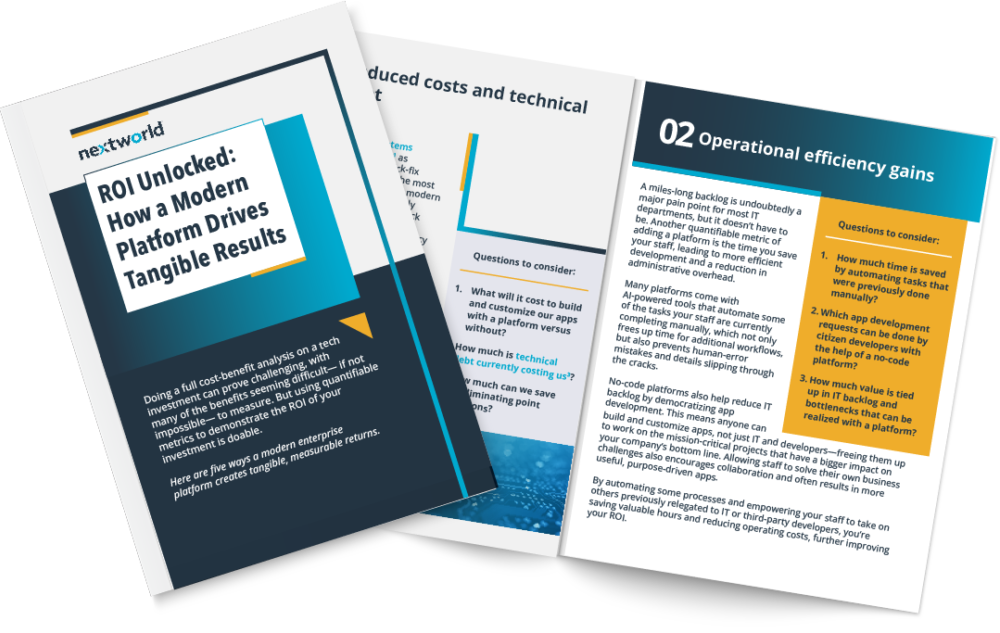
ROI Unlocked: How a Modern Platform Drives Tangible Results
Doing a full cost-benefit analysis on a tech investment can prove challenging, with many of the benefits seeming difficult, if not impossible, to measure. Using quantifiable metrics to demonstrate the ROI of such an investment is doable, however.
Here are five ways a modern enterprise platform creates tangible, measurable returns.
1. Reduced costs and technical debt
Over time, legacy systems accumulate tech debt as customizations and quick-fix patches pile up. One of the most impactful advantages of a modern platform is that it seamlessly integrates into your tech stack while minimizing the need to update and maintain your legacy architecture directly.
On average, adding a platform eliminates the need for eight individual point solutions. You can build your own custom applications, bypassing the need for specialized developers and avoiding additional tech debt.
Skip the costly, time-consuming development projects and spend fewer resources on maintenance, upgrades, and troubleshooting with a modern enterprise platform.
Questions to consider:
- What will it cost to build and customize our apps with a platform versus without?
- How much is technical debt currently costing us?
- How much can we save by eliminating point solutions?
2. Operational efficiency gains
A miles-long backlog is undoubtedly a major pain point for most IT departments, but it doesn't have to be. Another quantifiable metric of adding a platform is the time you save your staff, leading to more efficient development and a reduction in administrative overhead.
Many platforms come with AI-powered tools that automate some of the tasks your staff are currently completing manually, which not only frees up time for additional workflows, but also prevents human-error mistakes and details slipping through the cracks.
No-code platforms also help reduce IT backlog by democratizing app development. This means anyone can build and customize apps, not just IT and developers—freeing them up to work on the mission-critical projects that have a bigger impact on your company's bottom line. Allowing staff to solve their own business challenges also encourages collaboration and often results in more useful, purpose-driven apps.
By automating some processes and empowering your staff to take on others previously relegated to IT or third-party developers, you're saving valuable hours and reducing operating costs, further improving your ROI.
Questions to consider:
- How much time is saved by automating tasks that were previously done manually?
- Which app development requests can be done by citizen developers with the help of a no-code platform?
- How much value is tied up in IT backlog and bottlenecks that can be realized with a platform?
Anticipate changing industry standards and customer demands. Make the lightning-fast decisions required to stay agile and maintain a competitive edge.
3. Agility and scalability improve time-to-value
According to the 2024 KPMG US Technology Survey Report, more than 80 percent of US businesses have trouble keeping up with the constantly evolving tech landscape. AI-powered platforms enable you to anticipate changing industry standards and customer demands—and allow you to make the lightning-fast decisions required to stay agile and maintain a competitive edge.
Responding to changes in the market is vital in every industry, but many businesses were founded on legacy technology not equipped to adapt and pivot in real time. Agile, no-code development allows companies to build, test, and deploy new apps and features with unprecedented speed. Reduced iteration cycles mean you can continuously refine your solutions, accelerating time-to-market and boosting profits.
More with less is the goal, and the scalability a platform affords means you are always prepared for short-term demand fluctuations while staying focused on long-term growth. Faster application development, streamlined processes, and enhanced decision-making capabilities all contribute to increased profits, translating directly to increased returns on your tech investment.
Questions to consider:
- How much time was shaved off the product development cycle?
- How much quicker are we able to iterate and improve solutions based on customer feedback?
- What percentage of our investment is being recouped through improved efficiency, scalability, and faster time-to-market?
4. Business intelligence insights
Good data management reduces costs related to errors and poor decision-making. With robust reporting and analytics tools built in, cloud-native platforms make real-time data accessible anytime, anywhere.
And automated processing vastly reduce the number of reporting mistakes made due to human error, meaning more reliable data and less time and money spent on manual reconciliation efforts. Additionally, AI and machine learning algorithms can analyze data to show trends, detect anomalies, and predict potential disruption.
Interactive dashboards allow you to visualize data patterns, providing real-time insights that help identify cost-saving opportunities and eliminate waste. Tracking key performance metrics, including revenues, customer satisfaction, and operational efficiencies, ensures you always have the latest data necessary to make informed decisions that drive growth.
Questions to consider:
- How many fewer costly mistakes were made after automating processes?
- Did AI/ML detect any anomalies in data that prevented a disruption in operations?
- Did our dashboards help us identify any cost-saving measures we might have otherwise missed?
5. Security and regulation compliance
Businesses are often required to comply with rules and regulations set by government or industry-specific regulatory bodies, which requires constant diligence. Noncompliance fines are nothing to balk at, either. According to Good Jobs First, corporations pay out more than $50 billion dollars due to misconduct every year in the United States alone.
Platform providers also offer tools to ensure compliance with location and industry-specific standards, such as GDPR, HIPAA, GAAP, and IFRS. Customizing your applications to include compliance with these standards can prevent costly fines.
Most legacy architectures predate today's top security features, including single sign-on (SSO), encryption, and role-based access, making integrating them into systems difficult and costly. Modern platforms, however, are built with these capabilities in mind.
Entrusting a modern platform with the latest risk and security measures reduces the likelihood of data breaches and noncompliance issues, leaving your business one less thing to worry about.
Questions to consider:
- What is our security incidence rate?
- Did our security measures prevent any cyber attacks?
- Have we improved our compliance record since adopting a platform?
Proof that Platform Adoption Delivers
Fleetnet America®, a fleet vehicle service provider, adopted the Nextworld enterprise platform to aid in streamlining its invoice-settlement process without interrupting its legacy EBS system. Nextworld's No-Code Studio helped FleetNet create a custom invoice-settlement application, a feature the company desperately needed in order to retire its manual process of documenting invoices and calculating customer settlement agreements.
Nextworld's Accounts Payable and Accounts Receivable modules, as well as the Financials, Procurement, and Sales business suites—all of which seamlessly integrated into the company's legacy ERP—completed the modernization of FleetNet's system.
Automating processes at FleetNet increased productivity, allowing the team to handle more transactions without additional staff, leading to an increase in operating revenues and a positive ROI.

Remaining Future Proof
As with any new addition to your tech stack, adopting a modern platform is an investment. But it's a sustainable investment. Because they are designed to evolve alongside your business, your ROI grows over time, rather than diminishing upon implementation.
Best-in-class platforms adapt to new technologies as they emerge, allowing you to automatically take advantage—no costly overhauls required. New tools and functionalities are incorporated without disrupting your existing systems, always providing opportunities for business improvement.
By investing in a platform designed to adapt and scale, companies unlock a cycle of continuous ROI. Every enhancement, integration, and new application builds on the previous one, creating a stronger, more efficient, and more profitable enterprise over time.
What's Next? Putting ROI Metrics Into Action
Implementing a modern enterprise platform is a strategic investment that promises lasting ROI. But to fully realize that potential, businesses need a clear plan for measuring, tracking, and maximizing the impact of their platform over time.
Here's how to get started.
Establish baseline measurements
Before adding a modern platform to your tech stack, you'll want to establish benchmarks to measure ROI accurately. Document ongoing expenses related to maintenance, upgrades, and custom developments, as well as KPIs like time-to-market, error rates, and user satisfaction. Doing so will help you clearly demonstrate the value of your platform investment over time.
Track and report ROI regularly
Leverage dashboards and reporting tools
Align technology investments with business goals
What to Look for in a Modern Platform
Not all platforms are created equal. To ensure you're investing in a solution that will drive ROI, consider:
Cloud-native architecture
Seamlessly scale and adapt without infrastructure limitations.
AI-powered capabilities
Leverage machine learning and predictive analytics to enhance decision-making.
API-led integration
Ensure compatibility across your entire tech stack for smoother, faster deployments.
Enterprise-grade security
Protect your data and maintain compliance with rigorous security standards.
No-code development
Empower business users to innovate without heavy reliance on IT resources.
Mobility-first design
Provide remote access and mobile capabilities to keep your teams agile and connected.
By establishing clear benchmarks, actively tracking progress, and aligning your technology investments with your strategic goals, you can maximize ROI and future-proof your organization.
A modern platform is more than just a technology upgrade—it's a long-term investment in your business's growth, efficiency, and adaptability.
Be Ready for What's Next with Nextworld
The Nextworld Platform combines no-code development, composable applications, and a cloud-native foundation together in one powerful solution for your most complex and mission-critical business needs. Build and tailor enterprise-grade applications with advanced logic and automation—without compromising flexibility and scalability.
Connect to any ERP or business system to consolidate data and deliver real-time visibility across your enterprise. Drive innovation faster with rapid development, all backed by enterprise-grade security.
Learn how Nextworld is helping companies uncover real ROI. Watch a demo or schedule a custom workshop today.
ROI Unlocked: How a Modern Platform Drives Tangible Results